Patterns · Claude synthesis
Finding qualitative patterns without inventing market consensus
Claude research produces rich language, not automatic percentages. motpinmir shows how B2B teams compare accounts, tag recurring friction, and carry patterns forward into positioning — with explicit limits.

Comparison lens
What patterns are — and are not
Signal
Qualitative pattern
- Repeated phrases across unlike accounts
- Friction that survives role changes
- Behaviors visible in touchpoints and transcripts
- Named with buyer vocabulary, not jargon
Noise
Survey theater
- Top-two-box charts from tiny samples
- Persona averages that hide vetoes
- Themes copied from last quarter’s deck
- Claims of “the market wants” without context
8–15
Interviews before early themes
3+
Accounts per theme to trust repetition
1
Dissenting quote worth more than polite agreement
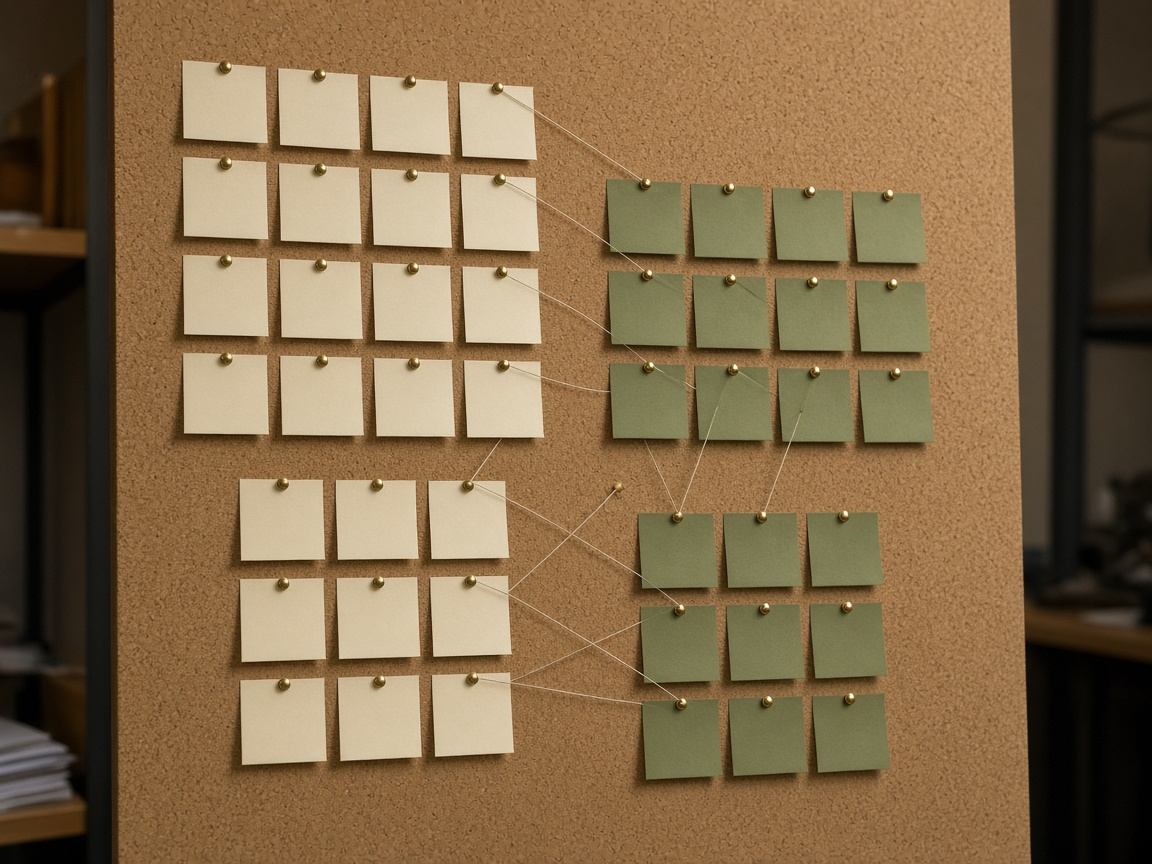
Pattern work begins where customer interviews end — with transcripts, field notes, and artifacts that still carry context. Claude teams resist premature dashboards. Instead, they extract verbatim lines that explain delay, doubt, or internal conflict, then cluster by mechanism rather than by feature request.
A mechanism might be “integration fear after a failed rollout” or “procurement reframing price as compliance risk.” Those clusters become qualitative patterns: named, evidenced, and linked to roles when possible. Patterns that only appear in one segment stay flagged as hypotheses, not board-ready truths.
Process timeline
Six steps from raw Claude notes to pattern maps
-
Step 1
Freeze the corpus
Lock transcripts and observation logs for a defined period. Mixing new interviews mid-cycle blurs what changed — the market or your sample.
-
Step 2
Line-level highlight
Mark sentences where buyers describe trade-offs, workarounds, or informal vetoes. Ignore feature wishlists until mechanisms are visible.
-
Step 3
Open code, then tighten
Use open labels first; merge only when two codes consistently co-occur across accounts. Keep a reject pile for one-off anecdotes.
-
Step 4
Compare segments
Contrast enterprise vs mid-market, or new-logo vs renewal, in a simple matrix. Patterns that hold across segments earn priority.
-
Step 5
Link to friction and touchpoints
Connect each pattern to purchase friction stages and the touchpoints where it surfaces. Disconnected themes die in slide decks.
-
Step 6
Hand off to positioning synthesis
Patterns become claim boundaries: what you can say, what you must qualify, and what requires more access. See positioning synthesis for the next move.
Pattern maps should embarrass bad positioning
If your messaging cannot point to at least three independent accounts echoing a pattern, it is still advertising — not Claude evidence.
Continue to positioning synthesis